Budapest’s Castle Hill is one long history lesson. This walk turns the Royal Palace area into a story you can see, from medieval foundations to 20th-century reconstructions. You’ll connect architecture to power plays, faith, trade, and siege—without needing a museum ticket spree.
I especially like how the guide keeps the pace human for a 3 hours 30 minutes walk. Two standouts for me: the palace’s changing look over centuries, and the medieval street sections that show how people actually lived and traded below the court. It’s also a small group, max 12, so your questions don’t get lost in the crowd.
One consideration: this is a lot of uphill walking on uneven stone streets. If you have limited mobility, this one is not suitable, and it’s also best saved for good weather since the tour requires it.
In This Review
- Key takeaways before you go
- Royal Palace storytelling, not just postcard views
- Sigismund Church foundations: the quiet proof of early palace building
- Tárnok Street: medieval merchants under Gothic façades
- Úri Street and medieval gateways you can walk under
- Church of Saint Mary Magdalene: a tower that survived regime-era demolition
- Országház Street: the Italian Street and one rare surviving sgraffito
- Neo-Gothic finance building and the politics of rebuilding
- Matthias Church: understand the official name, then watch the crowds
- Fortuna Street and the first printed Hungarian book
- Market memories at Becsi Kapu Square
- National Archives: medieval-minded architecture from the early 1900s
- The Siege of Buda route: walls, breach points, and a multinational fall
- Medieval Jewish quarter: an included interior stop that changes the pace
- Reused medieval walls on Táncsics Mihály Street
- Dominikánus Udvar and the Hilton Hotel’s controversial blend
- Fisherman’s Bastion: see the King Saint Stephen statue, skip the upper terrace
- What you’re really paying for: value at $43.25
- How the tour works on the ground (pace, comfort, and who it fits)
- The guide factor: why the experience lands at 5 out of 5
- Should you book the Buda Castle Tour?
- FAQ
- How long is the Buda Castle Tour?
- Is the tour offered in English?
- What’s included in the price?
- Which paid stops are not included?
- Is the Jewish Praying House visit always available?
- How big is the group?
- Are children allowed?
- Where does the tour start and end?
- Does the tour run in all weather?
- What should I know about walking and mobility?
Key takeaways before you go
- A Royal Palace with layers: Gothic, Baroque, and Neoclassical elements come from repeated rebuilds and political shifts.
- Medieval commerce on Tárnok and Úri Streets: you’ll see how burghers and nobles shaped the built environment.
- Jewish heritage with a real interior stop: the Jewish praying house visit is included (closed Saturday and Monday).
- Siege of Buda scars around the walls: memorial points mark where the 1686 breach and fall events happened.
- Iconic viewpoints, but no ticket add-ons: you’ll see key landmarks from the main level, while certain interiors/terraces stay optional.
Royal Palace storytelling, not just postcard views
Buda Castle District is famous for its views, but this tour is built for the other side of the experience: how the place got made and remade. The Royal Palace area is the headline, but the real value is understanding why different parts look the way they do.
Stop 1 is the Royal Palace itself, and the tour frames it as an architectural survivor. Over the centuries, it was built, destroyed, and rebuilt again and again. You’ll hear how a medieval stronghold slowly transformed into a royal residence that reflected changing tastes and power struggles—so you start seeing the building like a timeline instead of a single monument.
This tour also keeps expectations realistic about tickets. At the palace stop, the time is set for orientation and visual study rather than a full interior visit. If you want to go inside the Royal Palace afterward, that’s your choice—interior admission is not included.
You can also read our reviews of more historical tours in Budapest


Sigismund Church foundations: the quiet proof of early palace building
Right after the palace, you pause at the remains of the medieval Sigismund Church. This is a short stop, but it matters because it shows an early 15th-century Gothic royal chapel phase tucked into the palace complex story.
Today, you can still spot the foundations visible in the courtyards below. That means you’re not just hearing about the medieval court—you’re looking at where a major royal construction began when King Sigismund pushed the palace toward an imperial residence role. It’s one of those moments where the site itself does the talking.
Because it’s brief and focused on physical traces, I treat this stop like a mental warm-up for the rest of the walk. You’ll start noticing patterns: foundation lines, architectural changes, and what was preserved versus erased.
Tárnok Street: medieval merchants under Gothic façades
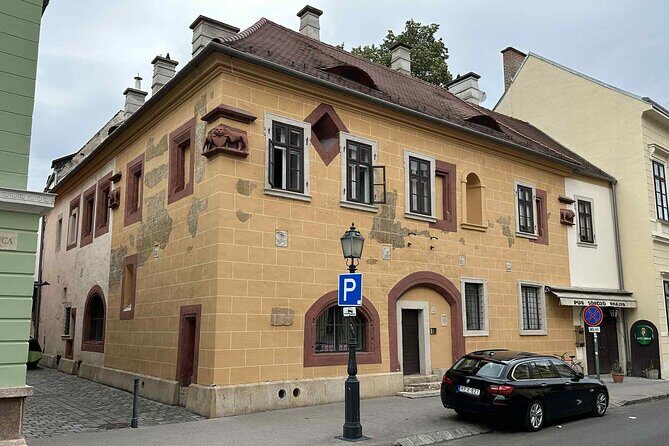
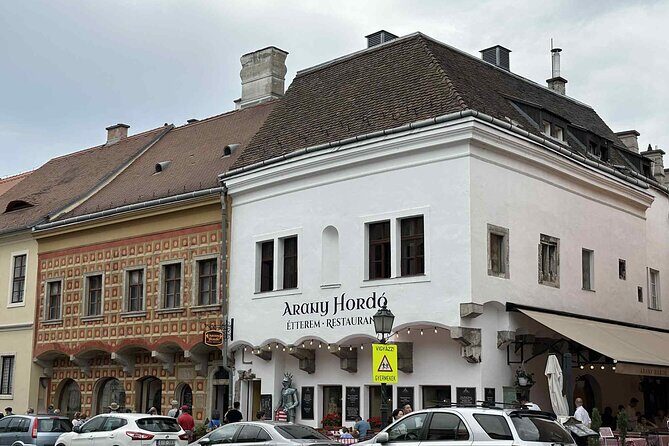
If you like history that feels practical, Tárnok Street is the stop that usually clicks. This is the main commercial street of the former burgher town beneath the royal court, and it’s paved and layered enough to feel medieval without needing special effects.
The tour approach here is smart. Instead of pushing big-ticket palace themes, you look at merchant houses that survived fires, siege, and centuries of urban change. You’ll learn what was stored, traded, and displayed—basically how commerce shaped daily life for the burghers who lived below the court.
It’s also one of the few stretches where architecture tells you about routine. A palace can be about power. Tárnok Street is about supply, storage, and money moving through a city.
Practical tip: wear shoes with good grip. The cobbles are part of the experience, and they’re also part of the traction problem.
Úri Street and medieval gateways you can walk under
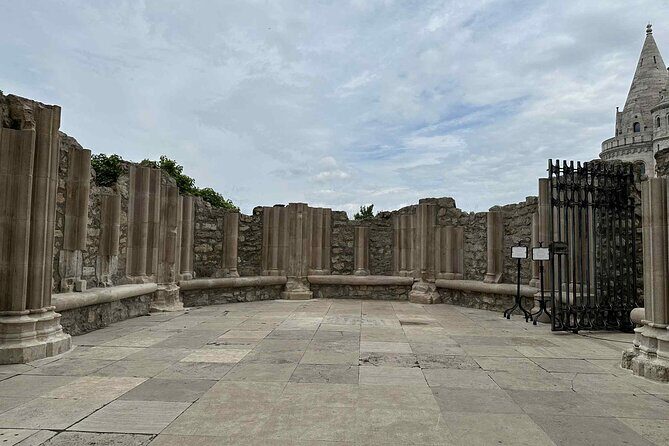
Úri Street shifts the mood from burghers to nobles. This area was a noble residential quarter in medieval Buda, and the tour points out remnants of palaces and houses built on 14th–15th century foundations.
Here, you get two useful angles at once. First, you learn how aristocratic status translated into thick stone walls and architectural “presence.” Second, the street is known for a collection of medieval gateways, ornate entrances that once welcomed merchants, craftsmen, and travelers.
Walking under those arches changes how you picture medieval movement through the city. It’s not abstract. You’re literally under the passage where people would have entered, negotiated, and gone on their way.
If you’re someone who likes doors, arches, and the details around entry points, you’ll enjoy the close attention on Úri Street.
Church of Saint Mary Magdalene: a tower that survived regime-era demolition
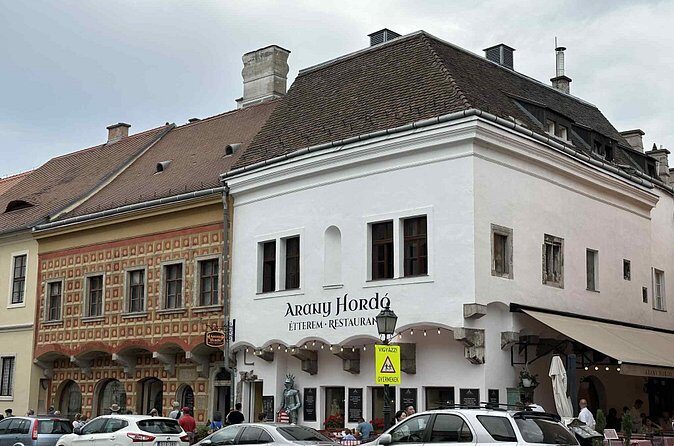
Churches on Castle Hill can be tricky because the story can be buried under layers of later rebuilding and renaming. This stop is different: the Church of Saint Mary Magdalene is a lesson in survival and loss.
The church was built on the site of the earliest church on Castle Hill, and its foundations go back to the 13th century. It was partially destroyed during the siege of Buda in 1686, then later demolished in the 1950s when Hungary’s communist regime ordered the removal of the ruined structure.
What you see today is the solitary medieval tower that survived thanks to efforts by archaeologists and preservationists. It’s a powerful visual for how heritage isn’t only about ancient beauty—it’s also about people choosing what to save after tragedy.
This stop is short, but it gives you a grounded emotional note before the tour continues into more outward-looking streets and landmarks.






Országház Street: the Italian Street and one rare surviving sgraffito
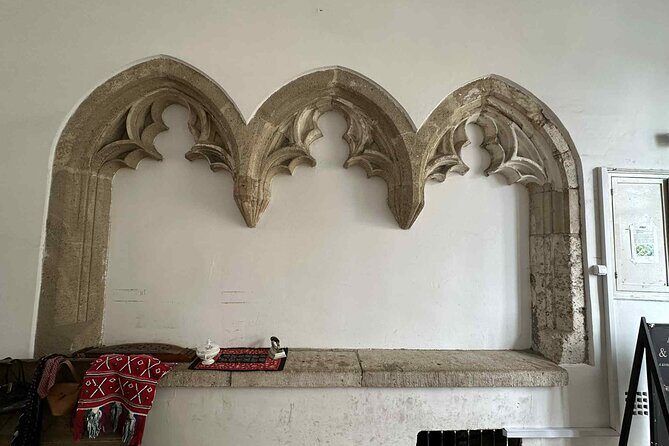
Országház Street, once called the Italian Street, adds a European trade angle that balances the Hungarian court focus. The tour explains that Italian merchants played a key role in Buda’s commercial and cultural life in the 14th and 15th centuries.
On this lane, you’ll be shown grand medieval houses and noble residences. It’s a good moment to connect the dots between architecture and international commerce—how trade networks shape what gets built and how rich neighborhoods look.
Then the tour highlights a specific detail: the only surviving 16th-century sgraffito decoration in the entire Castle District. That’s the kind of fact that makes you look closer at surfaces, not just shapes.
Even if you don’t think of yourself as an architecture person, that rare surviving detail turns your attention from general admiration into actual looking.
Neo-Gothic finance building and the politics of rebuilding
One of the more modern stops is the Volt Magyar Királyi Pénzügyminisztérium building, now the Ministry of Finance. It’s Neo-Gothic, built in the early 20th century, and the tour doesn’t pretend it appeared without controversy.
The monumental design came after several medieval structures were demolished. During World War II the building was damaged, and later its ornate façade was stripped and simplified. In the past five years, its original façade has been reconstructed—but the process sparked debate because part of an original wing was demolished to make the reconstruction happen.
This stop is valuable because it shows a pattern you’ll see across the district: rebuilding has winners and losers. Past layers weren’t always protected. Even when restoration looks like a win, it can still carry trade-offs.
If you like thinking critically about heritage, this is one of the best pauses on the tour.
Matthias Church: understand the official name, then watch the crowds
Matthias Church is iconic, and it’s also easy to misunderstand. The tour clears it up: the official name is the Church of the Assumption of the Buda Castle, and it’s often incorrectly called Matthias Church.
The tour frames the church through its community roots. Originally, it served Buda’s German-speaking population, which adds context for why this landmark fits into a broader mix of cultures and faith traditions on Castle Hill.
Important practical point: you’ll see the church from the outside and around the main area, but interior admission is not included. If you want to go inside, you can decide after the tour ends.
Even just viewing it helps you place the rest of the walk. You’ll look back at the streets and towers and realize the whole district is one connected religious and civic network.
Fortuna Street and the first printed Hungarian book
Fortuna Street feels calm today, but the tour explains how different it was in the Middle Ages. It was once home to aristocratic palaces and grand townhouses, and it held a milestone in Hungarian publishing.
In the 1470s, Andreas Hess, a German-born printer, produced Hungary’s first printed book here: Chronica Hungarorum. A few steps away in the past was the Red Hedgehog Inn (Vörös Sün), a legendary meeting point for travelers, merchants, and intellectuals.
That’s the kind of detail that makes a quiet street feel like a busy node of ideas. It’s also a nice reminder that culture isn’t only created in palaces—it moves through inns, workshops, and print shops.
If you’re short on time in Budapest and want one street-based story to remember, Fortuna Street is a great candidate.
Market memories at Becsi Kapu Square
Becsi Kapu Square helps you picture the social side of medieval Buda. The tour describes it as once a marketplace and an important entrance to the medieval city.
You’ll learn how Hungarian townsfolk and the local Jewish community came together to trade, talk, and worship. Today the square still carries historic charm, so it’s not just a lesson—it’s a place you can stand in and imagine the daily rhythm.
This stop also works as a transition. After learning about commerce on Tárnok and Úri Streets, you get to see where commerce and community converged at a city access point.
Take a minute here. Look around. Then let the names you’ve learned start connecting into a mental map.
National Archives: medieval-minded architecture from the early 1900s
The National Archives of Hungary is early 20th-century, but the tour explains why it looks like it belongs in a medieval district. The building is Neo-Romanesque, designed to echo and elevate the Castle Hill character.
It uses robust stonework and arched windows and has a monumental presence that makes it appear older than it is. The tour also frames it as more than architecture—it symbolizes national memory and houses documents covering Hungary’s written past.
This stop is useful even if you’re not planning to read archival material. It changes how you see “modern” buildings in historical neighborhoods. Here, the goal wasn’t to shock the past—it was to speak to it.
The Siege of Buda route: walls, breach points, and a multinational fall
As you walk along the outer castle walls, the tour shifts into the 1686 Siege of Buda. The stops here are not about dramatic battles for their own sake. They’re about physical places tied to key moments.
You’ll see where the walls were first breached by the allied forces, and nearby you learn about the fall of the Ottoman Pasha of Buda. A memorial honors multinational Christian soldiers who fought and died in the liberation of the city.
This section is important because it gives weight to what you otherwise might treat as scenery. When you stand by the outer walls, the siege story stops being a paragraph in a textbook.
If you want the emotional tone of the whole day in one stretch, this is it.
Medieval Jewish quarter: an included interior stop that changes the pace
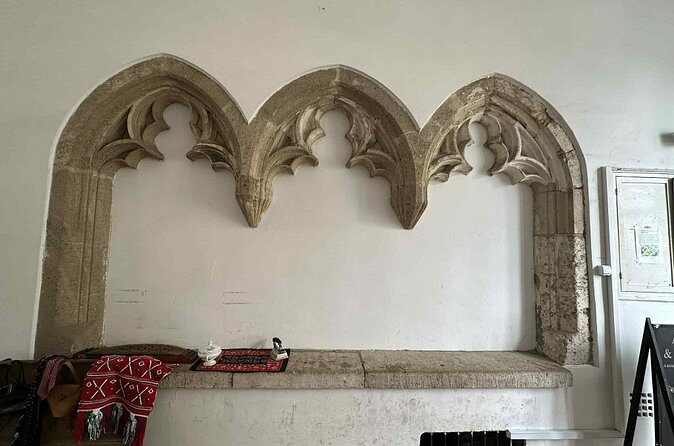
This is one of the biggest value points on the tour. You’ll enter the medieval Jewish quarter area and pause at the site of the former Gothic synagogue. The tour notes the synagogue was destroyed, and the walk then moves to a preserved site with excavated medieval Jewish prayer-house remains.
The included highlight is the Jewish praying house interior. It’s described as one of the rare surviving examples of Jewish religious architecture from the Middle Ages in Hungary. The stop is modest in size, but the meaning is heavy, and the tone becomes quiet and reflective.
One practical catch: the Jewish Praying House is closed on Saturday and Monday. So if you’re picking a tour date, check the day of week and plan accordingly.
This is also where I think the small-group format matters. It’s easier to hear details and ask questions in a calmer setting.
Reused medieval walls on Táncsics Mihály Street
Táncsics Mihály utca shows how Buda didn’t erase its medieval past—it reused parts of it. Here, older Gothic walls and cellars weren’t demolished. Instead, they were incorporated into Baroque and later residential buildings.
That layered approach is visible in the façades and in the way the older structures got folded into newer needs. You get a literal example of post-Ottoman rebuilding rising atop medieval foundations, both symbolically and physically.
This stop works especially well after the Jewish quarter visit. You’re now seeing how different communities lived over time in the same general space—even when politics shifted.
Dominikánus Udvar and the Hilton Hotel’s controversial blend
At Dominikánus Udvar, you encounter ruins of the Dominican monastery of Saint Nicholas. The tour connects this spot to Friar Julianus and his legendary 13th-century journey.
Then it moves into the modern controversy. The ruins endured fire and siege and neglect, but were later reinterpreted during Hilton Hotel construction in the 20th century. The result is a mix of medieval stonework and modern architecture, described as controversial.
This is one of those places where you can stand in the modern context and still spot the older material. It also makes you think about conservation versus development in real life, not just in theory.
If you hate debates about restoration, you might find this stop a little uncomfortable. If you like honest context, it’s fascinating.
Fisherman’s Bastion: see the King Saint Stephen statue, skip the upper terrace
Fisherman’s Bastion is one of Budapest’s recognizable landmarks, and the tour doesn’t ignore that. At the center stands the equestrian statue of King Saint Stephen, Hungary’s first Christian king, representing the birth of the Hungarian state.
You’ll admire the monument and the structure from the main level, but you won’t enter the upper panoramic lookout terrace. Access requires a ticket and is not included in the tour price.
This is smart for time. You still get the iconic view framing, but you avoid the extra queue and ticket step. If you do want the upper terrace panorama, plan to purchase tickets after.
Since this tour ends at the Matthias Church area, it’s also a good idea to think about how you want to spend your final hour: church interior, upper terrace, or just wandering.
What you’re really paying for: value at $43.25
The tour price is $43.25 per person, and for 3 hours 30 minutes it’s largely about interpretation rather than paid attractions. Many stops are outside or at visible remains, where admission is free for what you’re doing on the walk.
Your included admissions are key: the Jewish praying house entrance fee is included, and that stop is the one place where the tour goes beyond exterior viewing. You’re also buying a licensed English-speaking guide’s time, plus the benefit of a small group capped at 12.
If you were to DIY this district, you could certainly wander the streets. But you’d likely miss the connections—the reason Tárnok Street matters, the significance of the sgraffito detail, and the specific Siege of Buda location story points.
So I see the value as a guide that helps you read the district like a document: layer by layer, and not just as a scenic backdrop.
How the tour works on the ground (pace, comfort, and who it fits)
Expect a walking-heavy format with moderate physical fitness recommended. You’ll cover multiple streets, courtyards, wall-side areas, and landmark points.
It’s also not suitable for guests with limited mobility, which matters because the area involves uneven surfaces and stairs or steep sections you can’t avoid.
Good weather is required. If rain is on the forecast, you’ll likely be offered a different date or a full refund, so don’t stress too much. Just plan on comfortable shoes and a light layer—Castle Hill can feel sharper than the riverfront.
This tour fits best if you want history and architecture tied together, and if you like small-group experiences with real Q and A. It’s also ideal for first-timers who want orientation across the Castle District without picking off sights one by one.
The guide factor: why the experience lands at 5 out of 5
The standout theme in the feedback is the guide’s passion and ability to connect history to buildings. Máté (also written as Mathew in some notes) is repeatedly praised for being friendly, funny, and full of architectural and archaeological context.
What I find especially practical is the use of visual support. In the materials shared during tours, the guide reportedly uses photos and illustrations on an iPad to help you picture how buildings looked in earlier eras. That’s not extra fluff. It turns ruins and façades into something your brain can reconstruct.
Also, the smaller group size helps with attention. When the guide can answer questions and keep the pace manageable, the whole route feels less like a checklist and more like a guided conversation.
Should you book the Buda Castle Tour?
If you’re coming to Budapest for the first time and you care about what buildings mean—not just what they look like—this is a strong pick. The mix of Royal Palace layers, medieval street life, Jewish quarter sites, and Siege of Buda context gives you a full picture without a museum binge.
Book it if you like architecture details like gateways, sgraffito decoration, and foundation remains. Also book it if you want an English guide who can explain why the district looks the way it does.
Skip it or think carefully if your mobility is limited, if you strongly need interiors (Royal Palace interior and Matthias Church interior are not included), or if you’re only interested in views. This tour is a walking history lesson, and it works best when you’re ready to look closely.
FAQ
How long is the Buda Castle Tour?
The tour runs about 3 hours 30 minutes.
Is the tour offered in English?
Yes. It’s offered in English.
What’s included in the price?
The price includes an official licensed English-speaking guide and the entrance fee to the Jewish Praying House. You also get a guest pass with a lanyard.
Which paid stops are not included?
Admission to the interior of Matthias Church is not included, the upper panoramic terrace access at Fisherman’s Bastion is not included, and the Royal Palace interior admission is not included.
Is the Jewish Praying House visit always available?
It’s included, but the Jewish Praying House is closed on Saturday and Monday.
How big is the group?
The tour has a maximum of 12 travelers.
Are children allowed?
Children under 10 years old are not permitted.
Where does the tour start and end?
It starts at the Statue of Prince Eugene of Savoy (Budapest, 1013 Hungary) and ends at Matthias Church near Szentháromság Square (Budapest, Mátyás Templom, Szentháromság tér 2, 1014 Hungary).
Does the tour run in all weather?
The experience requires good weather. If it’s canceled due to poor weather, you’ll be offered a different date or a full refund.
What should I know about walking and mobility?
A moderate physical fitness level is recommended, and the tour is not suitable for guests with limited mobility.