REVIEW · BUDAPEST
Budapest Highlights Bike Tour with a local guide
Book on Viator →Operated by Budapest Bike Breeze · Bookable on Viator
Pedal power beats tour buses. This small-group ride is a smart way to see Budapest fast, using bike streets and squares that big vehicles can’t reach. You’ll cover iconic stops like Heroes’ Square, the Parliament, and the Buda Castle views, while a local guide keeps Hungarian history moving in plain, real-world stories.
What I like most is the mix of “wow” landmarks with practical pacing. The bikes are reported to be in really good condition, and guides such as Balázs, Katy, and Dany (plus Bowlash) bring the kind of detail that makes the city’s past click. The one thing to consider is route comfort: if your ride includes the Chain Bridge area, it can feel tight and busy, with the narrow approach and no dedicated bike lane in that stretch.
This tour is built for moderate fitness. If you’re comfortable pedaling for about 3.5 hours, you’ll be in good shape; if not, you’ll want to plan on slowing down at the stops.
In This Review
- Key highlights worth circling on your map
- Pedal-Proofing Budapest: why this 3.5-hour route works
- Start at Rumbach Sebestyén u. 10: getting oriented before you zoom
- Elizabeth Square to Andrassy Avenue: the city’s story in order
- Heroes’ Square and Vajdahunyad Castle: monuments plus a fairy-tale setting
- City Park rhythm: House of Music and a thermal-bath culture crash course
- Basilica to House of Terror: faith, symbols, and heavy truth
- Szabadság tér to the Parliament: from Soviet memory to national power
- Bridges and Castle Garden: Danube views you’ll actually plan around
- Price and value: what $42.05 gets you in real terms
- Who this tour is best for (and who should skip it)
- Should you book Budapest Bike Breeze?
- FAQ
- How long is the Budapest Highlights Bike Tour?
- What does the tour cost per person?
- Is the tour offered in English?
- How big is the group?
- Where does the tour start and end?
- What time does the tour begin?
- Are tickets to the main sights included?
- Do I need a certain fitness level?
- Is cancellation free if I change plans?
Key highlights worth circling on your map
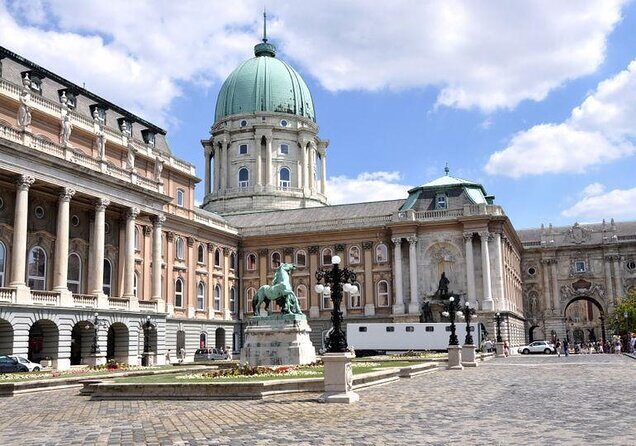
- Car-free-feeling sightseeing: ride along narrow streets and squares where cars and buses can’t go
- UNESCO on two wheels: Andrássy Avenue’s neo-Renaissance boulevard stretch
- History that lands in real places: tight stops that connect architecture, politics, and daily life
- Danube and Buda Castle panoramas: multiple scenic pauses for photos and orientation
- A guide makes the difference: named guides in the mix include Balázs, Katy, and Dany
Pedal-Proofing Budapest: why this 3.5-hour route works
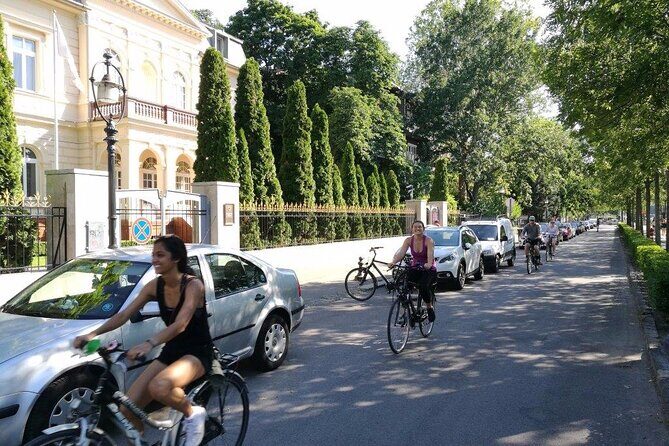
A 3.5-hour bike tour is a sweet spot in Budapest. You don’t just “see” things—you get the city’s rhythm. Budapest has big, photogenic landmarks, but it also has the narrow connections between them: the little squares, boulevards, and park edges that make the whole place feel walkable and lived-in.
This tour leans into that. You’ll ride at a light pace with few stops in the long boulevard stretches, then use short, focused stops to learn what you’re looking at. It’s eco-friendly by design, but the bigger win is practical: you cover far more than most half-days on foot.
The group size is capped at 12 travelers, which helps you stay together without feeling like a moving circus. And it runs in English, so you can actually follow the stories instead of guessing.
You can also read our reviews of more cycling tours in Budapest


Start at Rumbach Sebestyén u. 10: getting oriented before you zoom
The ride starts and ends at Budapest, Rumbach Sebestyén u. 10 (near public transportation). The start time is 10:00 am, which is great for two reasons. First, daylight makes the Danube-and-Buda views look their best. Second, by late morning you’ve already had time to get breakfast and coffee, so you don’t arrive rushed.
The early minutes matter because Budapest has two halves: Pest and Buda, plus the river that separates them. This tour helps you build that mental map quickly. You begin on the Pest side, then work your way toward Parliament, bridges, and the Castle area—so the views feel like progress instead of random photo stops.
You’ll also be on a moderate-fitness schedule. That means some pedaling energy, even if you’re not sprinting. For me, that’s the right trade-off: you get movement, but you still get enough stops to actually absorb the city.
Elizabeth Square to Andrassy Avenue: the city’s story in order
Stop 1 is Elizabeth Square, a lush start point with the Budapest Eye Ferris wheel and the Danube Fountain nearby. It’s the kind of place where the guide can sketch Budapest’s broad timeline in minutes. You get a quick orientation: where the big sights sit, how the Danube shapes the city, and why the next stretch matters.
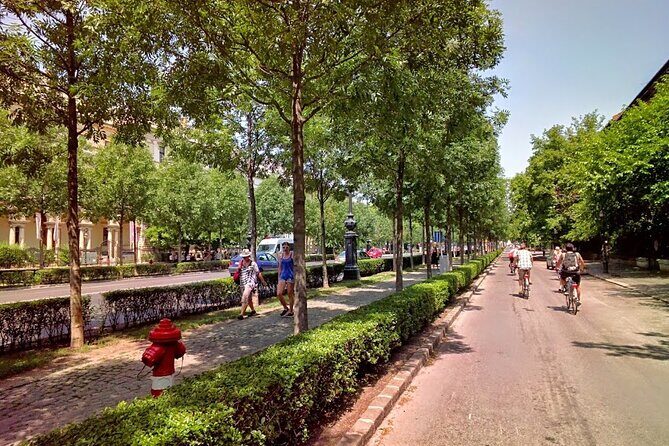
Then you ride to Andrassy Avenue (Stop 2), one of Budapest’s most prestigious boulevards and a UNESCO World Heritage Site. This is a “ride it like a boulevard” segment. Expect a light pace and minimal interruptions, because Andrassy Avenue is about flow—neo-Renaissance architecture, long lines of buildings, and a street that feels grand even when you’re moving at bike speed.
Stop 3 is the Hungarian State Opera House (Magyar Állami Operaház). You pause at this stunning neo-Renaissance building and get the background on Hungarian musicians and the Opera house itself. One detail that’s especially useful here is the mention of the first subway line of the continent—because it ties the Opera area to how Budapest grew modern transit around major cultural landmarks. If you like linking buildings to systems (not just facts), this stop is worth it.
Heroes’ Square and Vajdahunyad Castle: monuments plus a fairy-tale setting
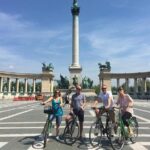
Heroes’ Square (Stop 4) is classic Budapest drama. It’s surrounded by the Millennium Monument and statues of Hungary’s important historical figures. The guide focuses on Hungarian history and statesmen, but the real value is spatial. Standing there on a bike tour route, you can actually see how this square acts like a civic stage—wide, ceremonial, and designed to impress.
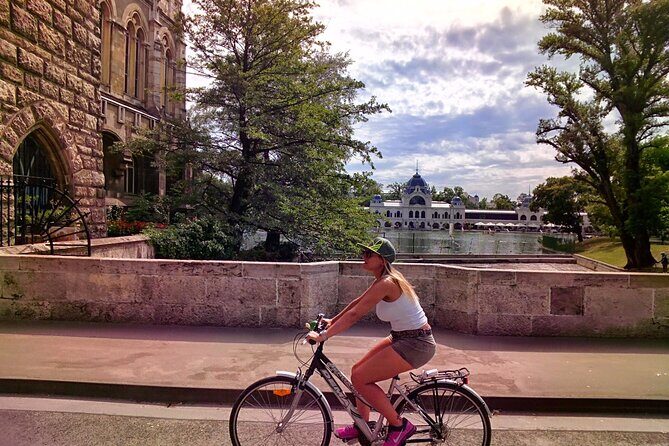
Next comes Vajdahunyad Castle (Stop 5), in City Park. This is where the tour shifts from “power” to “picture-book.” The castle complex shows different Hungarian architectural styles, almost like a quick museum of what Hungary wanted to be and remember. It also houses the Museum of Hungarian Agriculture, so it’s not just decorative.
You’ll also notice the lake around the castle area. In winter, it’s used as Budapest’s scenic ice-rink, which is a great mental hook for planning your visit seasonally. Even if you’re there in warmer months, the idea makes the area feel like it has a second life.
City Park rhythm: House of Music and a thermal-bath culture crash course
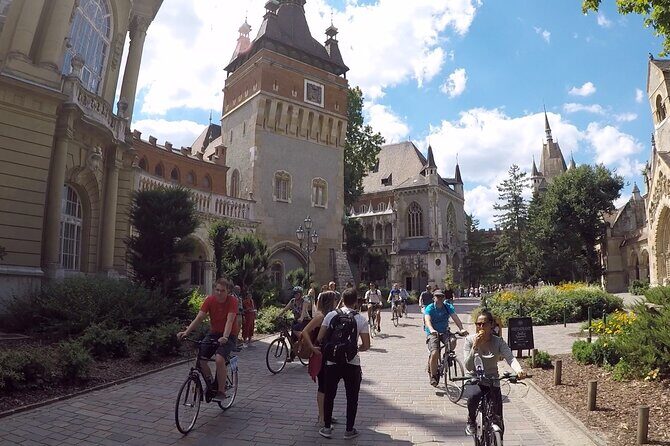
After the castle area, the tour continues through City Park (Varosliget) with stops that keep the pacing easy. You ride the lush park lanes and take a break by the lake again (Stop 8), which helps reset your legs before the more intense landmark section later.
Then there’s the House of Music Hungary (Stop 6). It’s a striking cultural venue, and the key is that it mixes music history with interactive exhibitions. Even if you don’t go inside, stopping here on a bike tour gives you a sense of Budapest as a city that doesn’t only preserve old monuments—it also builds modern experiences around music and learning.
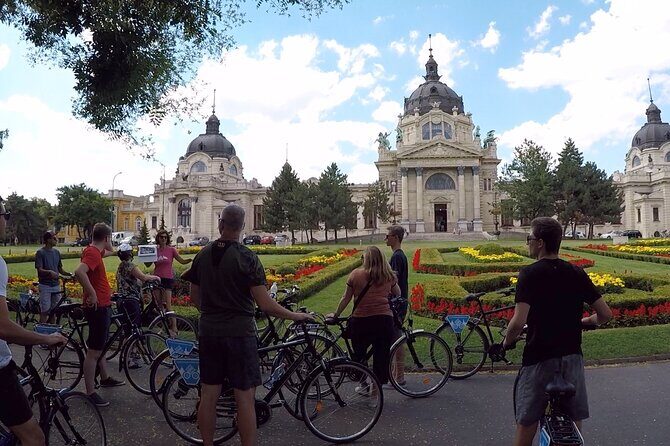
The tour also includes a quick look at Széchenyi Baths and Pool (Stop 7). This is a big one. The guide explains Hungarian thermal bath culture, and you get context for why these baths are more than a tourist photo spot—they’re part wellness, part social tradition, and part architecture. The Neo-Baroque look is the kind of thing you’ll remember later when you drive past other bath facilities and realize what makes Széchenyi special.
Note: admission for certain major sights is not included. For the Baths, expect the stop and explanation rather than full entry.
You can also read our reviews of more guided tours in Budapest





Basilica to House of Terror: faith, symbols, and heavy truth
St. Stephen’s Basilica (Szent István Bazilika) is Stop 9. You’ll learn about the origins and religions of Hungarians, plus a famous detail tied to the holy right hand. Even if you’re not a religious-history person, this stop helps you understand why certain symbols and relic stories matter in Hungarian identity.
Then comes the House of Terror Museum (Stop 10). This is the emotional pivot of the tour. The building was used as Gestapo and Communist secret police headquarters, and you’ll also see a piece of the Berlin wall here. The guide frames it as a place that commemorates victims of Hungary’s fascist and communist regimes, with exhibits that reflect the country’s struggle with oppression and totalitarianism.
It’s not a “happy” stop, but it’s a crucial one if you want more than postcard Budapest. On a bike tour, this works because you’re not just reading labels—you’re walking past the physical structure and then moving on, so you don’t feel trapped in one mood for hours.
Szabadság tér to the Parliament: from Soviet memory to national power
Szabadság tér (Stop 11) is another quick lesson with visual payoff. You see the last standing Soviet army memorial in Budapest, framed by grand historic buildings and monuments. The atmosphere is described as peaceful, which can feel surprising at first—until you realize memorials often create a quiet space for reflection rather than drama.
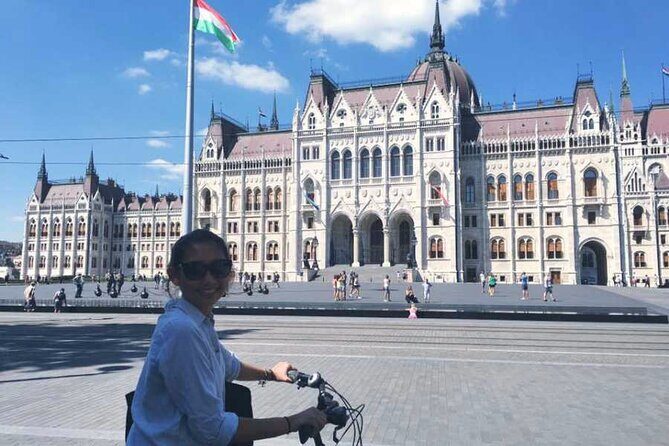
Then you reach the Hungarian Parliament Building (Stop 12), a neo-Gothic icon. The guide explains why it’s the third largest Parliament building in the world and points out that it’s home to Hungary’s National Assembly and the Holy Crown. That last part matters: the Parliament isn’t just a pretty facade; it’s tied to the symbols Hungary built its legitimacy around.
Like other big-ticket stops, admission is not included here—so you’re getting the perspective and the key takeaways, not a timed entry ticket.
Bridges and Castle Garden: Danube views you’ll actually plan around
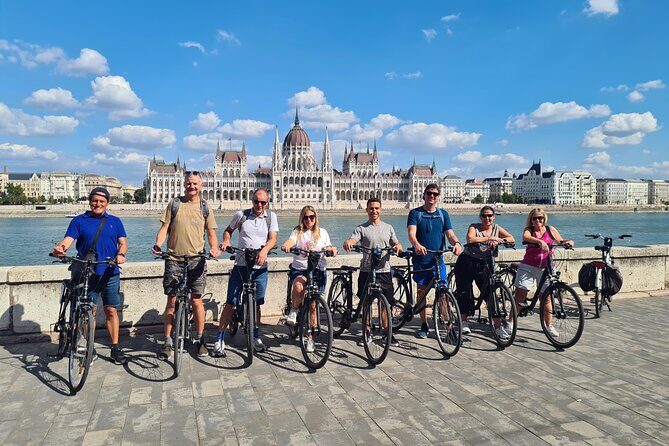
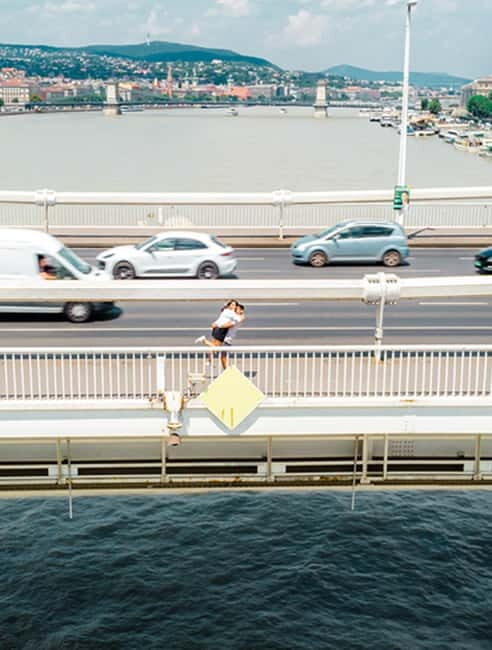
Between the Parliament area and the Castle side, the tour includes bridge moments and panorama time. You’ll admire what the guide frames as Budapest’s first bridge and ride along it with Danube-and-Buda views. If your route includes the Chain Bridge stretch, keep one thought in mind: it can be narrow, busy, and not bike-friendly in the way the rest of the ride is. One practical piece of advice: stay alert, go slow through merges, and trust your guide’s calls.
After the bridge views, you’ll get additional Castle-area panoramas while riding along the Danube, plus recommendations for what to walk around once you’re off the bike. This is one of the tour’s best “future planning” features. A lot of first-time visitors stand near Buda Castle and feel lost. Here, you’re getting just enough orientation to make walking later smoother.
The ride finishes with Castle Garden (the restored neo-Renaissance park, Stop 13). You’ll hear about Buda Castle and the Royal palace, and you’ll get a calm, Danube-facing ending with terraces, fountains, and peaceful walkways. This stop feels like a breath after the heavier museum and the civic landmarks—still historic, just less intense.
Price and value: what $42.05 gets you in real terms
At about $42.05 per person for roughly 3 hours 30 minutes, this is priced like a true city experience rather than a “pay for a ticketed attraction” deal. The value comes from stacking multiple major zones in one guided ride: UNESCO boulevard, landmark squares, Opera area context, museum interpretation, and Castle panoramas—plus the convenience of having it all connected by bike.
You also get the practical benefits that tend to cost extra if you plan separately: a guide to explain what you’re seeing, a compact route that reduces backtracking, and bike quality. Reviews mention bikes in really good condition and good cycle lanes, which matters in Budapest where street conditions can vary block to block.
The trade-off is that several major sights are stops without included admission (Opera, Baths, Basilica, House of Terror, Parliament, for example). So if your priority is paying once and entering everything, this won’t fully replace ticketed museum visits. But if your priority is orientation, stories, and planning your next moves, it’s a strong bargain.
Who this tour is best for (and who should skip it)
This is ideal if you want a first-shot introduction to Budapest without spending a full day only walking. It’s also a solid fit if you like learning that stays tied to what you’re standing in front of—Hungarian symbols, political history, and why certain buildings matter.
You should consider another plan if:
- you’re not comfortable riding a bike for most of a half-day
- narrow, busy bridge stretches would stress you out (especially around the Chain Bridge area)
- you mainly want indoor time and ticketed entry rather than guided outdoor stops
Should you book Budapest Bike Breeze?
If you want a high-impact Budapest overview—Andrássy Avenue to Parliament to Buda Castle views—this is the kind of tour that makes the rest of your trip easier. The small group size helps, the English guidance is built for understanding, and the mix of uplifting architecture with the House of Terror stop gives you a balanced sense of the country.
My rule of thumb: book it early in your trip. Then use the Castle-area recommendations and the history framing to guide your next day walks.
FAQ
How long is the Budapest Highlights Bike Tour?
It’s about 3 hours 30 minutes.
What does the tour cost per person?
The price is $42.05 per person.
Is the tour offered in English?
Yes, it’s offered in English.
How big is the group?
The tour has a maximum of 12 travelers.
Where does the tour start and end?
It starts at Budapest, Rumbach Sebestyén u. 10, 1075 Hungary, and ends back at the same meeting point.
What time does the tour begin?
The start time is 10:00 am.
Are tickets to the main sights included?
Admission is not included for several stops such as the Hungarian State Opera House, Széchenyi Baths, St. Stephen’s Basilica, House of Terror Museum, and the Hungarian Parliament Building.
Do I need a certain fitness level?
You should have a moderate physical fitness level.
Is cancellation free if I change plans?
Free cancellation is available if you cancel up to 24 hours in advance for a full refund.