REVIEW · BUDAPEST
Private Tour of Communist Era Budapest
Book on Viator →Operated by Tamas Varga · Bookable on Viator
Budapest has another layer, and it’s in plain sight. This private day traces Hungary’s communist story through real neighborhoods, not just speeches, with Tamas Varga pairing context with on-the-ground sights and personal memories. I like that you get Memento Park and the city’s communist-era housing and industry in one sweep, plus time for preserved places like Bambi Café. One possible drawback: it’s a long day, and if traffic runs heavy, you may have to trade off one optional stop (like the Retro interactive museum) for the essentials.
You’ll ride in an air-conditioned vehicle and move between symbols, everyday life, and the architecture meant to shape people’s minds. You’ll also get a neutral, factual approach—more history lesson, less propaganda cosplay. At the start, the guide checks how deep you want to go and adjusts on the fly, which is a big deal when you’re paying for a private tour and want it to fit your curiosity.
If you’re coming to Budapest for the classics but want the “other Budapest,” this tour does that job without feeling like a textbook. You should just know you’ll walk a bit, stop often, and spend meaningful time outdoors at viewpoints.
In This Review
- Key things to notice before you go
- A route that turns symbols into street-level understanding
- Szabadság Square and the “Stalin Baroque” courtyard details
- House of Terror, viewed from the outside first
- Bem Square and 1956: where the revolution started
- Bambi Café presszó: a communist-era time capsule you can taste
- Marczibányi Cultural Centre: architecture for supervised youth
- Hotel Budapest and Gellért Hill: skyline messaging meets “liberation”
- Socialist Realism on campus: Budapest University buildings
- Fehérvári Way market and a real lunch away from crowds
- Brutalist church, tower blocks, and life designed to last
- Memento Park: the final act of communist symbols
- Csepel Island: industrial working-class power, called Red Csepel
- Gubacsi Road and Retro interactive history: from housing transitions to fun
- Price and value: what $245 buys you in real terms
- Who should book this communist-era Budapest tour
- Final call: should you book this day in Budapest?
- FAQ
- How long is the Private Tour of Communist Era Budapest?
- Is the tour private?
- What languages is the tour offered in?
- Do you provide hotel pickup?
- Is admission included for Memento Park?
- Is admission included for the Budapest Retro Interactive Museum?
- Is lunch included?
- What’s included in the tour besides the guide and vehicle?
- Can I still climb to the Liberty Statue during renovation?
- Can I get a full refund if I cancel?
Key things to notice before you go
- Pickup in Budapest so the day starts smoothly and you’re not hunting transit between districts
- Neutral storytelling that explains occupations, Soviet control, and the 1956 revolution without turning it into a one-note rant
- Preserved communist-era interiors like Bambi Café (a presszó time capsule)
- Architecture as evidence, from Stalin Baroque details to socialist realist campuses and brutalist housing planning
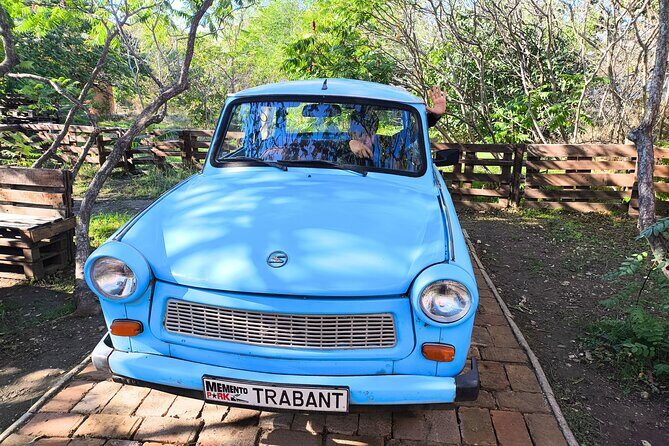
- The emotional endpoint at Memento Park, with huge regime statues outdoors and a Trabant to sit in
A route that turns symbols into street-level understanding
The value of this tour isn’t any single stop. It’s the way the route links together political power, propaganda-style architecture, and how people actually lived in the built environment. You start downtown with occupation and dictatorship context, then follow the story outward to housing estates, factories, and the final phase represented by Memento Park.
I like the pacing because it mixes heavy topics with real-life texture. You’ll pause at places that look ordinary at first glance—then the guide explains why the details matter. That’s when the city changes from a postcard to a document you can read.
Also, since it’s private, the guide can respond to your questions. In practice, that means you can ask for more context around 1940s occupation, the late-1940s Stalinist grip, the 1956 uprising, or the industrial working-class angle tied to Csepel.
You can also read our reviews of more private tours in Budapest



Szabadság Square and the “Stalin Baroque” courtyard details
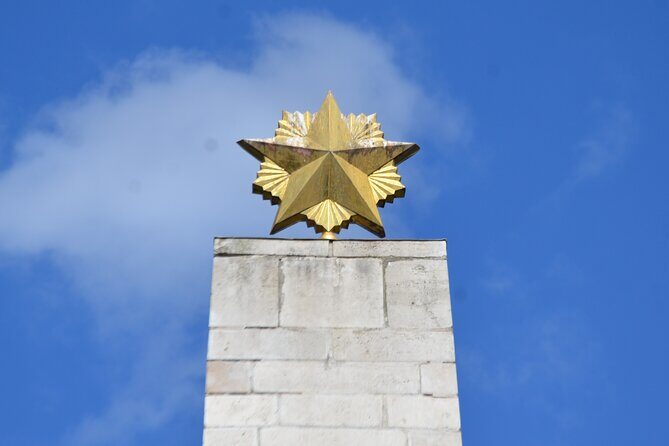
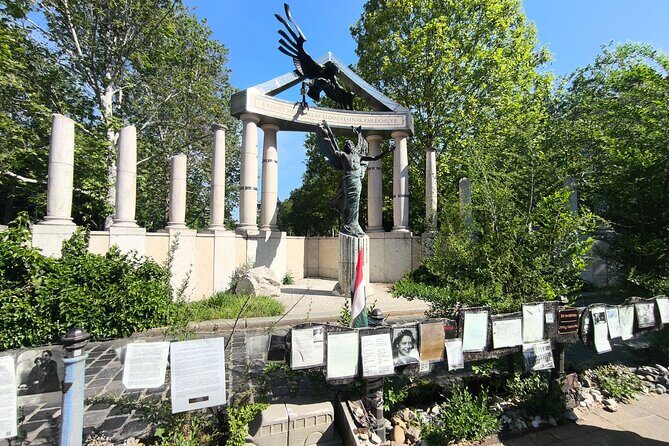
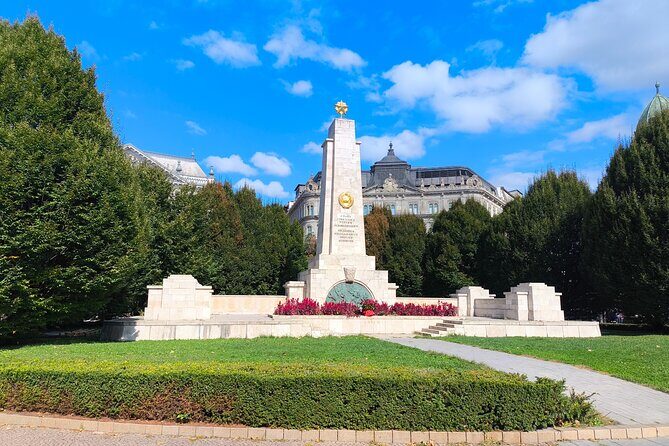
You begin at Szabadság Square, where the memorials frame the story at the scale Hungary understood: occupation, liberation narratives, and what came after. You’ll get a short overview of the events that helped the Communists take power, then a look at the Soviet liberation memorial that set the stage for the dictatorship years of the late 1940s and early 1950s.
From there, you move to a nearby square with some of the few remaining examples of Socialist Realism, sometimes called Stalin Baroque. The key payoff here is not just admiring buildings, but spotting the kinds of reliefs and decorative choices meant to communicate power. Even the strange charm—like a statue of a bear riding a scooter—works as a reminder that propaganda cities also contain everyday oddities.
This stop is short enough that you won’t burn out, but it gives you the baseline that makes later places land harder.
House of Terror, viewed from the outside first
Next up is the House of Terror at 60 Andrássy Avenue. This building carries layers: it was used by the fascist Arrow Cross Party during World War II and later became the central office of the communist secret police, the ÁVH.
You won’t enter during this tour, so treat this as a guided orientation. The building itself is the lesson—what the structure represents, and how totalitarian regimes reuse space and symbols. If you later want more, you can visit the museum independently, but getting the framing first makes the museum experience less random.
The main drawback is simple: if you love museum-style deep reading, an exterior-only stop can feel light. Still, the rest of the day is dense, and this keeps the schedule moving.
Bem Square and 1956: where the revolution started
On the Buda side, you stop at Bem József Memorial on Bem Square, where the 1956 Hungarian revolution ignited. The guide explains why this square mattered—how protests sparked here and then spread across Budapest.
This is a quick stop, but it’s emotionally important. You’re not just hearing dates; you’re seeing where momentum began. That makes later contrasts—like how the regime’s power was displayed afterward—feel less like abstract history.
If you’re sensitive to political violence topics, this section stays within a respectful overview, but the subject matter is still real.
Bambi Café presszó: a communist-era time capsule you can taste
Then you slow down a bit with Bambi Café, a preserved communist-era coffee house or presszó. This is the kind of stop that changes the whole mood of the day, because it shifts from ideology to routine: a place where people sat, talked, drank, and waited while the larger system did its work.
Even if you keep it to a brief drink, the preserved décor matters. It gives you a sense of how everyday culture continued inside strict political conditions. It also helps you avoid the “all heaviness, no breathing” feeling that can come from topic-heavy tours.
If you get tired of museum-type stops, this is a good moment to reset.




Marczibányi Cultural Centre: architecture for supervised youth
At Marczibányi Square Culture Centre (Marczibányi Téri Művelődési Központ), built in 1972, you get a quick look inside the reception hall. The point here is how communist systems tried to shape youth culture.
Instead of beat concerts or gatherings deemed questionable, the center offered meaningful activities—while still staying carefully supervised. The architecture and the interior atmosphere help you see that as a design choice, not just a policy.
This stop is brief, so you don’t need to be an architecture fanatic to enjoy it. If you are one, you’ll probably clock the way the building organizes space and social flow.
Hotel Budapest and Gellért Hill: skyline messaging meets “liberation”
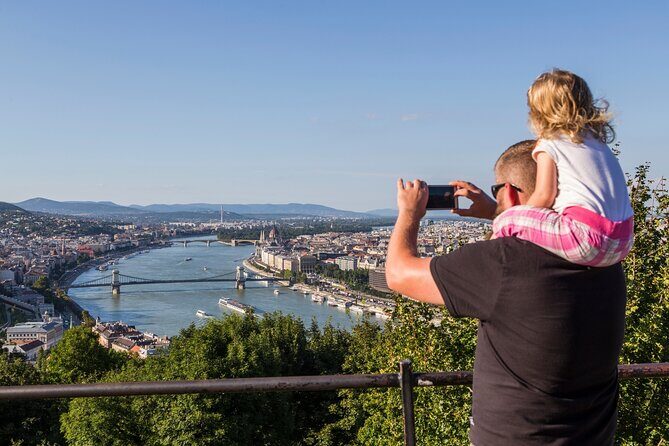
One of the more visually memorable stops is Hotel Budapest, the circular skyscraper completed in 1967. It’s an iconic shape that many tourists miss, but from the city and even from airplanes you can spot it.
The guide ties the design to political messaging: socialist countries could also build skyscrapers. The tour then connects this to what happened in Hungary after the 1956 revolution—an era often described as Goulash Communism, sometimes called the block’s happiest barrack.
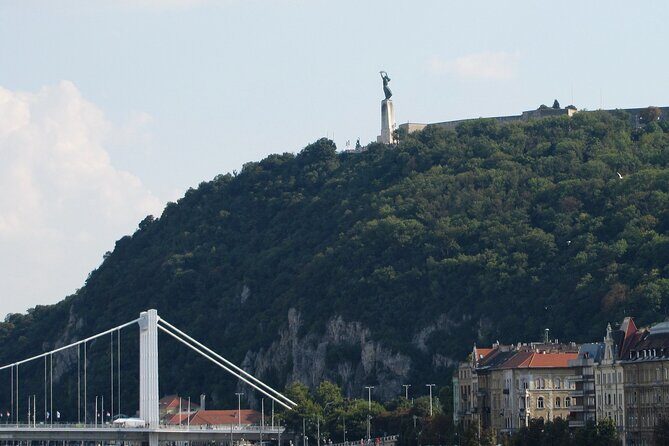
After that, you head to Gellért Hill and Liberty Statue, also known as the Liberation Monument. The statue was unveiled on April 5, 1947, and the inscription once referred to memory of the liberating Soviet heroes. You’ll hear about Erzsébet Gaál, the young nurse whose likeness modeled the statue—and how that role became both a blessing and a curse.
Important practical note: the statue and Citadel area are currently under renovation (expected to reopen in December 2025). You can still walk around, climb the steps up to the monument, and enjoy lookout views while you’re there.
Socialist Realism on campus: Budapest University buildings
Next you’ll see part of Budapest University of Technology and Economics, with its large examples of socialist realist architecture. The tour focuses on the H, T, and R buildings, especially the facade of the R building.
If you’ve been wondering why “ideology” shows up in stone and windows, this is where the answer becomes physical. You’ll also have a chance to enter on weekdays. The guide even sets expectations with a wink that inside, you might feel like you’re stepping into Moscow—then explains what that feeling is tied to.
This stop is short, but it helps you connect earlier symbols to an everyday institution: education.
Fehérvári Way market and a real lunch away from crowds
A big practical win is Fehérvári Way. The market hall began as a distinctive 1977 brutalist building, then later got a plain white exterior that covers the original structure. The guide reads this change as a kind of architectural misunderstanding and rejection of brutalist design principles.
Inside, you can look at the concrete surfaces and the innovative ramps, then browse and shop Hungarian goods if you want. The best part for many people is that this isn’t just sightseeing—it’s a chance to do normal market behavior while you’re learning.
Lunch is at Restaurant Alba Regia, a local favorite that stays away from heavy tourist circuits. You’ll get help choosing from a menu that’s only in Hungarian. If you like simple, hearty Hungarian food with a setting that feels lived-in, this is a smart use of your midday time.
Brutalist church, tower blocks, and life designed to last
You’ll also make stops tied to communist-era religious architecture and housing. The tour includes a church-like hidden spot built during the communist era, but constructed mostly from metal and in a brutalist style—so it doesn’t look like the worship spaces many people expect.
Then you visit a typical communist tower block estate and the estate’s urban center. The guide briefly covers how prefabricated housing estates were built and what life was like in that environment. Nearby, there’s a statue of three bulls that makes for an easy photo moment.
A particularly personal stop comes at the Children’s Dentistry site within the Experimental Housing Estate, where the guide lived until age six. That detail changes the emotional tone of the housing story. You stop thinking only about policy and start thinking about routine, childhood, and the texture of daily surroundings.
Memento Park: the final act of communist symbols
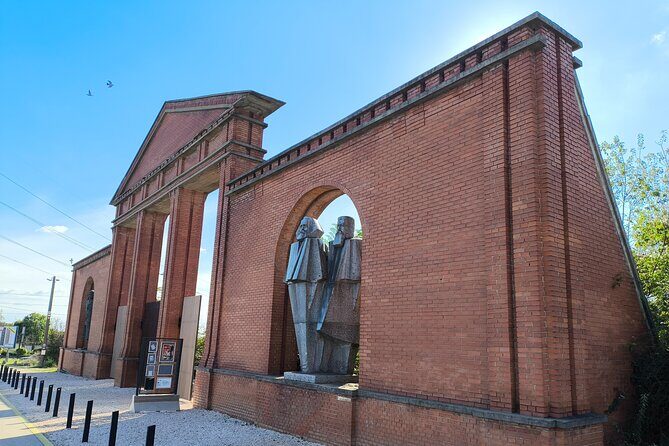
If there’s a must-do moment on this itinerary, it’s Memento Park. You walk into an open-air archive of the last years of Hungary’s communist dictatorship, filled with huge statues and monuments that once stood across Budapest as regime symbols.
The guide encourages you to read the symbolism in the artworks, then also to feel what happens when they decay outdoors: the scale stays, but the power fades in the open weather. It’s a strong transition from political architecture to the real aftermath.
You can even sit in a real East-German Trabant. It’s not historically accurate to the fantasy of glamour, but it gives you a tactile, unforgettable way to picture the era.
Note: Memento Park admission is not included and is listed as $9.00 per person.
Csepel Island: industrial working-class power, called Red Csepel
To understand why communism wasn’t only about buildings, you need factories. On Csepel Island, the area earned the nickname Red Csepel because of its role as an industrial hub and a working-class stronghold.
You visit the Csepel Iron Works, a massive industrial complex tied to Soviet-style industrialization. The guide explains how it employed tens of thousands of workers and produced steel, machinery, and vehicles. A key historical detail: Csepel workers played an important role in the 1956 revolution, holding out even when other areas had fallen.
As you look around, you also pass large communist-style tower block housing estates. The route helps you connect where people worked with where they lived—and how socialist realist art and architecture echoed through both.
Gubacsi Road and Retro interactive history: from housing transitions to fun
On Gubacsi Way, you see Gubacsi Road Housing Estate, a time capsule from post-war Hungary along the Ráckevei-Danube riverfront. The tour frames it as an architectural and social transition, moving from socialist realism toward modernism in the 1950s.
You’ll also spot rare ceramic reliefs that reference the area’s industrial and communist past. Even if you don’t care much about design theory, these details give you small “evidence pieces” that survive weather and paint.
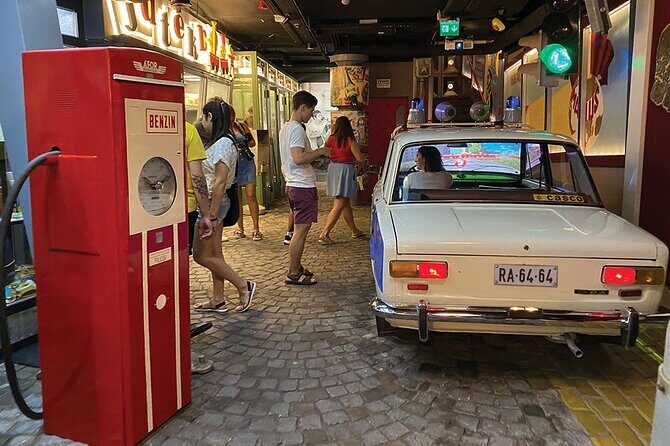
The final major stop is Budapest Retro Interactive Museum. It’s playful and hands-on: interactive exhibits about life during Communism and other eras, plus even themed experiences like a communist-era bistro after you finish exploring. It’s open daily, and it’s a good way to take the edge off an intense topic day.
This one isn’t included, and admission varies by weekend price (listed at $16.50 per person for the tour). If traffic makes timing tight, this stop is the one most likely to be shortened or skipped.
Price and value: what $245 buys you in real terms
At $245 per person, you’re paying for a private guide, a car with driver/guide, and a day packed with major sights that are hard to stitch together efficiently on your own. This isn’t a ticket-only experience. It’s interpretation—plus transportation that gets you from downtown to Buda to the island-industrial areas without stress.
What’s included:
- Pickup from your hotel or agreed location in Budapest
- English private guide (Tamas Varga)
- Air-conditioned vehicle and licensed driver/guide
- Soda/pop, bottled water, and snacks
- Mobile ticket
- Group discounts (if applicable)
What costs extra:
- Memento Park admission ($9.00 per person)
- Retro Interactive Museum admission (weekend price details given)
- Lunch is not included in the tour price
If you want lunch included, you should plan for that additional cost. But the benefit is that lunch is chosen and guided in a practical way, with help since the menu is Hungarian.
Who should book this communist-era Budapest tour
This tour fits you best if you like:
- City walks and architecture that tell political stories
- A guided pace that saves you from guessing where to go and what to notice
- History with context and personal perspective, not a one-sided myth version
You might not love it as much if you want only upbeat sightseeing or if you prefer fully self-directed museum time. The day is packed, and some stops are brief by design.
Final call: should you book this day in Budapest?
I’d book it if you want Budapest to explain itself beyond the usual highlights. The route covers the big anchors—Szabadság Square, the 1956 start point at Bem Square, the skyline symbolism at Hotel Budapest and Gellért Hill, then the housing and industrial side of the system—with a strong payoff at Memento Park.
Before you go, plan your expectations for timing. It’s a 7–10 hour day, and traffic can affect whether you get full time at the Retro museum. If you keep that flexible mindset, this private tour is a solid value for a first serious look at Hungary’s communist era through the city’s actual streets and buildings.
FAQ
How long is the Private Tour of Communist Era Budapest?
The tour runs about 7 to 10 hours.
Is the tour private?
Yes. It’s a private tour/activity, with only your group participating.
What languages is the tour offered in?
The tour is offered in English.
Do you provide hotel pickup?
Yes. The guide can pick you up at your hotel or another agreed location in Budapest at the scheduled time.
Is admission included for Memento Park?
No. Memento Park admission is not included and is listed as $9.00 per person.
Is admission included for the Budapest Retro Interactive Museum?
No. Retro Interactive Museum admission is not included, with weekend pricing listed and applied as $16.50 per person.
Is lunch included?
No. Lunch is not included in the tour price.
What’s included in the tour besides the guide and vehicle?
It includes soda/pop, bottled water, snacks, and travel in an air-conditioned certified passenger vehicle with a licensed professional driver/guide.
Can I still climb to the Liberty Statue during renovation?
The statue and Citadel are under renovation (expected to reopen in December 2025), but you can still walk around the site and climb the steps up to the monument.
Can I get a full refund if I cancel?
Yes, free cancellation is available up to 24 hours in advance for a full refund.