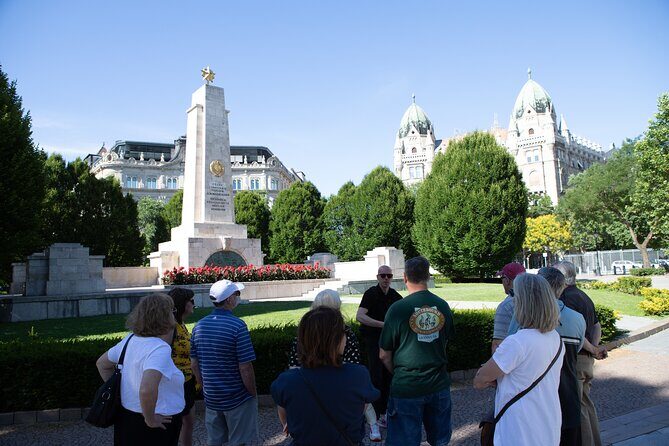
One uphill walk can change how you see a city. This private Buda Castle tour connects the Chain Bridge climb with the Castle district’s medieval leftovers, Baroque palace corners, and the big wow view over the Pest side. You’ll get a real sense of how Budapest grew upward, not just a checklist of monuments.
I especially like two things: first, you set the pace with a guide who can answer questions as you go, and second, the walk is focused on details that are easy to miss on your own. The other plus is practical city help, too, so the tour feels like it helps you enjoy Budapest after you’re done. One thing to consider: it’s a hillside walk with moderate fitness needed, so plan comfortable shoes.
In This Review
- Key Points You’ll Care About
- Castle Hill at the 170-Year-Old Chain Bridge Start
- Castle Garden Bazaar: A Smart, Elegant Way Up
- The Last Medieval Clues: 13th-Century Remains You Can Actually See
- The Baroque Palace Walk: 18th-Century Secrets Without the Headache
- Cobblestoned Streets to Matthias Church: Where the Story Gets Real
- Fisherman’s Bastion: The Pest-Side Wow Moment That Feels Earned
- Price and Logistics: Is $230 Per Group Good Value?
- Who This Buda Castle Tour Fits Best
- Should You Book Budapest Wonderguides Conquer the Castle?
- FAQ
- How much does the Budapest Buda side tour cost?
- How long is the tour?
- What time does the tour start?
- Is the tour private?
- What languages is the tour offered in?
- Do you get a guide and what’s included?
- Is pickup available?
- Is food or drinks included?
- What meeting point details are provided?
- Do you need a certain fitness level?
- Is cancellation free?
Key Points You’ll Care About
- Private guide for up to 6: small group pace, more questions, less waiting around
- Castle Garden Bazaar start: an elegant route that saves you from guessing how to get up
- 13th-century and 18th-century stops: medieval remnants plus Baroque palace flavor, in one route
- Matthias Church with clear sightlines: you’ll know what you’re looking at, not just where to stand
- Fisherman’s Bastion viewpoint: the Pest panorama lands at the right moment in the walk
- English guide and mobile ticket: straightforward logistics for a 9:00 am start
Castle Hill at the 170-Year-Old Chain Bridge Start
Most Budapest tours start with a postcard. This one starts with the city’s hinge point: the Buda side of the 170-year-old Chain Bridge. It’s a clever choice because you’re orienting yourself immediately—where Buda and Pest face each other, and why the Castle district matters from every angle.
Your walk begins at 9:00 am and runs about 4 hours. That time window is long enough for real sightseeing but short enough that you won’t feel like you spent half your holiday trapped on cobblestones. You’ll also be returning to the meeting point at the end, which helps when you’ve got more plans later in the day.
If you’re thinking about joining at a later hour, don’t. Morning light tends to make the view approach feel easier, and it also helps you avoid the hardest crowds around major photo spots. Also, since the tour is private (just your group), the pace stays yours instead of the clock’s.
What you’ll get out of the start: a mental map. Before you even hit Castle Hill proper, you’ll understand the layout enough to follow the route without constantly checking your phone.
You can also read our reviews of more tours and experiences in Budapest.



Castle Garden Bazaar: A Smart, Elegant Way Up
Getting from the bridge to the top can feel like a puzzle if you’re doing it alone. Here, the plan takes you through the Castle Garden Bazaar, which is described as the most elegant route to reach the Castle hill. Even if you’ve visited Budapest before, this approach tends to feel more “local” because it’s part market stroll, part shortcut, part city texture.
This is a useful stage of the tour for two reasons. First, you’re warming up into the climb instead of lunging up steep streets all at once. Second, bazaars and passageways give you an in-between Budapest layer—the kind of area where you learn how people move through the city, not just where famous buildings stand.
You also get the benefit of someone walking beside you who can point out what matters. Without that, it’s easy to wander through a pretty area and still miss why it’s there. With a guide, you can ask questions about what you’re seeing—architecture, neighborhood history, and how the city evolved.
A possible drawback: this segment can include uneven ground, and you’ll want shoes with grip. If your legs are sensitive, plan for short pauses when needed. The tour’s pacing is designed for your group, so don’t be shy about slowing down.
The Last Medieval Clues: 13th-Century Remains You Can Actually See
The tour doesn’t jump straight from “pretty” to “big church.” It slows down to show you the last remains of the medieval castle from the 13th century. That matters because medieval Budapest is more than a label. The Castle district carries layers, and those older traces are the difference between a sightseeing walk and a real understanding of place.
When you hit these remnants with a guide, you’re not just looking at stones. You’re learning how to read them: what’s original, what survived, and why these older structures still shape the district. Even if you’re not a medieval-architecture superfan, this section is usually where the tour feels most grounded.
The value here is context. When you know what came before the later palaces and churches, the rest of the route clicks into place. Without that, you can accidentally treat every building like a standalone postcard.
I like that this stop gives you a story to carry. Then, when you move to later centuries, you notice the contrasts more clearly. That’s how a walking tour turns into a perspective shift.
The Baroque Palace Walk: 18th-Century Secrets Without the Headache
Next up is an 18th-century Baroque palace walk, with time around the palace area so the guide can share its secrets. Baroque buildings can be intimidating when you don’t know what you’re looking for—ornament can blur into “pretty,” and facts can turn into a blur of dates.
This stop helps because it’s guided with the intent of making you pay attention. You’ll walk around the palace area and hear what the features were meant to do, what the design signals, and how that era’s tastes show up in the details.
Also, since this is a private tour, you can ask follow-up questions without slowing down strangers. If you want to spend an extra few minutes on one detail—say a specific style element or a structural feature—the pace is yours.
One practical consideration: Baroque and palace exteriors can be visually dense. If you’re the type who needs a moment to absorb, build that into your walking rhythm. The goal isn’t to rush. The goal is to leave with a clearer picture than you started with.
Cobblestoned Streets to Matthias Church: Where the Story Gets Real
Now you move into the heart of the Buda Castle district: colorful buildings and cobblestoned streets, leading all the way to Matthias Church. This is the part where the tour feels like it’s blending neighborhoods with monuments. You’re not only visiting a single site—you’re walking through the setting that makes the site feel alive.
Matthias Church is a major moment, and your guide’s job here is to help you see it with sharper eyes. You’ll likely hear what makes this church special—its look, its role in the story of Budapest, and how it connects to the city’s larger themes. The point isn’t memorizing facts. The point is knowing what you’re looking at, so your photos don’t end up as “random big building” shots.
This section also brings a nice emotional arc. You start with the bridge viewpoint logic, then you climb into medieval traces, then you shift into Baroque grandeur, and then the route lands at Matthias. It’s a steady ramp, not a chaotic sprint.
And because it’s a small group (up to 6 people), you’re less likely to get stuck behind a crowd. You’ll have more chances to position yourself for photos and for hearing the guide over street noise.



Fisherman’s Bastion: The Pest-Side Wow Moment That Feels Earned
At the end of the route, the tour reaches Fisherman’s Bastion, and that’s where you get the truly amazing view over the Pest side. This is the payoff. After hours of walking the Castle district streets and learning the layers of history, the panorama doesn’t feel tacked on. It feels like the point.
I like that this viewpoint arrives after you’ve built context. If you go to Fisherman’s Bastion too early, it can look like just another viewpoint. Here, it lands when you can appreciate what you’re looking at and why the Castle hill dominates the skyline.
You’ll likely have time to enjoy the view at a leisurely pace. In a private setup, you can linger without feeling like you’re holding up the group. It also makes it easier to take a few different angles—something you may not think about until someone points out where the best sightlines are.
If you’re planning more walking after the tour, keep in mind that the “wow moment” is also a momentum moment. If you still have energy, you can tack on nearby exploration. If you’re done, you’ll appreciate that the tour returns you back to the meeting point.
Price and Logistics: Is $230 Per Group Good Value?
Let’s talk money in plain terms. The price is $230 per group, up to 6 people, for about 4 hours with a local guide and a professional guide included. It’s private, English-speaking, and it includes a mobile ticket. Pickup is offered, and the tour ends back at the meeting point.
So the question isn’t only cost—it’s what you get for that cost. For Budapest, a private 4-hour Castle Hill experience can save you time and confusion. The route includes very specific stops: the Castle Garden Bazaar approach, medieval remnants from the 13th century, an 18th-century Baroque palace walk, Matthias Church, and Fisherman’s Bastion.
If you split the group cost across multiple people, it becomes a lot more reasonable than buying separate tickets or paying for multiple private guides. Even for couples, the private format often beats “big group cram” because you can ask questions and adjust pace without negotiating crowds.
I also like that the tour seems designed for efficiency. You’re not wandering aimlessly for hours hoping you’ll find the right streets. Someone is guiding you through a sequence that makes sense—historically and geographically.
What’s not included: food and drinks. That’s common for walking tours, but it matters for planning. If you want snacks, bring something small or plan a meal break before or after. Also, since you’re on moderate-fitness terrain, a light snack can help you keep a steady pace.
Who This Buda Castle Tour Fits Best
This tour fits best if you want three things: better context, a manageable walking route, and room to ask questions. It’s especially good for first-timers who want the Castle district to feel understandable instead of overwhelming.
I’d also recommend it if:
- you like history, but you don’t want a lecture with no time for questions
- you care about practical “how to get around” guidance during your day
- you prefer a small group pace instead of big-bus energy
- you want the best view stops without guessing which direction to walk next
It may be less ideal if you’re trying to do sightseeing mostly from the comfort of a stroller or if you have no patience for cobblestones. The tour notes moderate physical fitness needs, so think of it as a steady walking day, not a sit-everywhere tour.
Children are welcome, but they must be accompanied by an adult. Service animals are allowed, and the meeting area is near public transportation, which helps if you’re arriving on your own.
Should You Book Budapest Wonderguides Conquer the Castle?
If you’re on the fence, here’s my practical take: book it if you want the Castle district to make sense fast. This tour uses a smart route—from the Chain Bridge start through the Castle Garden Bazaar to medieval remnants, Baroque palace areas, Matthias Church, and finally the big Fisherman’s Bastion view. That’s not just sightseeing; it’s a guided explanation of how Buda’s layers connect.
Skip it only if you prefer totally independent exploring and you already know the Castle district well enough to read the streets and buildings without help. If you want a private guide and a focused sequence in about four hours, this is a strong choice.
One last tip: wear shoes you trust on stone. You’ll enjoy the views more when your feet feel steady.
FAQ
How much does the Budapest Buda side tour cost?
It costs $230.00 per group, for up to 6 people.
How long is the tour?
The duration is approximately 4 hours.
What time does the tour start?
It starts at 9:00 am.
Is the tour private?
Yes. It is a private tour/activity, and only your group will participate.
What languages is the tour offered in?
The tour is offered in English.
Do you get a guide and what’s included?
A local guide is included, and a professional guide is included.
Is pickup available?
Yes, pickup is offered.
Is food or drinks included?
No. Food and drinks are not included.
What meeting point details are provided?
The tour starts in Budapest, Hungary. It ends back at the meeting point.
Do you need a certain fitness level?
The tour is designed for travelers with a moderate physical fitness level.
Is cancellation free?
Yes, you can cancel for a full refund up to 24 hours in advance.