REVIEW · BUDAPEST
Budapest: Past & Present Jewish District Walk
Book on GetYourGuide →Operated by Triptobudapest · Bookable on GetYourGuide
Budapest’s Jewish District tells stories on every corner. This guided walk connects memory and modern life through courtyards, symbols, and street layouts, starting near the Budapest Eye and the Raoul Wallenberg Memorial. I love how the tour makes the area feel like a living neighborhood, not a museum, while also keeping the 20th-century story clear and handled with care. The main drawback: it is a walking tour, so you’ll want comfortable shoes and a basic fitness level for 1.5 hours at a relaxed pace.
Two things really work here. First, I like the way the guide ties Jewish heritage to everyday spaces—street signs, entrances, urban details—so the meaning sticks. Second, I like the balance: you get context on Jewish traditions (including both Ashkenazi and Sephardic influences) and then see how the ghetto-era history shaped what stands in the city today. If you want long, indoor synagogue time or a heavy focus on architecture only, this may feel more street-level than you expect.
The practical consideration is simple: it runs in English and you have limited public toilets along the route. Also, the tour has rules like no audio recording and no alcohol, so plan a normal sightsee vibe and save any drinks for later.
In This Review
- Key highlights worth your time
- Starting near Danubius Fountain, with the Budapest Eye in sight
- Deák Ferenc tér orientation: how the route makes sense before it gets emotional
- Dohány Street Synagogue exterior: the tour’s big anchor landmark
- Rumbach and Kazinczy Street Synagogues: heritage in the street plan
- Ghetto-era streets and the Budapest Ghetto Wall remains
- Courtyards and everyday urban details: where memory hides in plain sight
- Gozsdu Udvar and the shift to modern Budapest
- Street art and murals: memory updated for new generations
- Szimpla Kert: the ruin pub finish with practical orientation
- Price and value: $1.89 for a lot of guided context
- What to expect for comfort, pace, and rules
- Who this tour is best for
- Should you book the Budapest Past & Present Jewish District Walk?
- FAQ
- Where does the tour meet?
- How long is the walking tour?
- What language is the tour conducted in?
- Is the tour wheelchair accessible?
- What should I bring?
- Are there any rules during the tour?
- What is the refund and cancellation window?
Key highlights worth your time
- Raoul Wallenberg Memorial and Budapest Eye start: easy to find, good way to set the tone early
- Licensed local guide: clear explanations and room for questions
- Synagogue exteriors and Jewish symbols in plain sight: history you can see, not just hear
- Budapest Ghetto Wall remains and independent viewing tips: you leave knowing where to look next
- Everyday courtyards and passageways: the neighborhood feel stays real
- Finish at Szimpla Kert: a practical handoff to keep exploring after the walk
Starting near Danubius Fountain, with the Budapest Eye in sight
This walk begins in a very sensible place: by the Danubius Fountain, just about 10 to 15 meters from the Budapest Eye Ferris wheel, in the middle of the square. If you’re using Deák Ferenc tér as your hub (M1, M2, and M3 lines all meet there), you can get oriented quickly before you even start walking.
Right away, you’re in the right emotional zone. The Raoul Wallenberg Memorial is nearby, and that proximity nudges you into the tour’s core idea: the Jewish District is not just about the past in a distant way. It’s about how the city remembers, rebuilds, and keeps moving forward.
From the start, you’ll get a clean introduction to how the Jewish Quarter developed from the 19th century onward, and why it mattered for architecture, commerce, and community life. That early context helps the rest of the route make sense, instead of turning into a list of landmarks.
You can also read our reviews of more walking tours in Budapest



Deák Ferenc tér orientation: how the route makes sense before it gets emotional
A short segment brings you through the Deák Ferenc tér area and then into the Jewish District proper. Even with just a few minutes of walking, the guide’s job is already underway: setting the map in your head.
You’ll learn how the neighborhood formed and changed over time, including the way different Jewish communities shaped what you see in the streets. The tour also flags how later events, especially World War II and the 20th century, altered the district and left physical traces behind.
This is one of those details that makes the tour better than a casual stroll. When you understand the “why” up front, you’ll notice more later: layout, street choices, and the small symbols that would otherwise blend in.
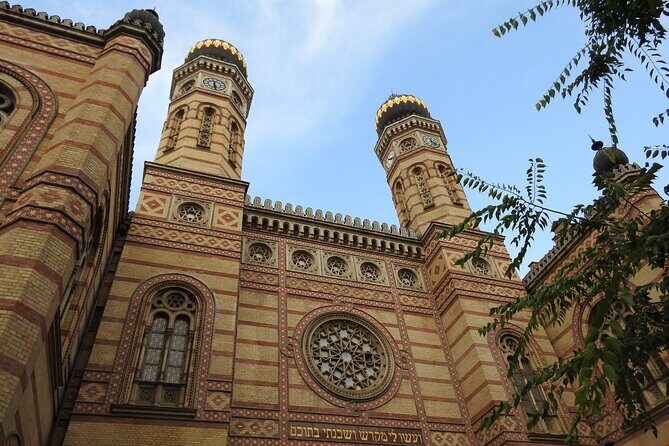
Dohány Street Synagogue exterior: the tour’s big anchor landmark
Dohány Street Synagogue is one of the first major visual markers on the route. You’ll get a guided look at the synagogue exterior and learn how it fits into the larger story of Jewish life in Budapest.
Even if you have only a basic interest, this stop helps you connect the dots. The guide uses the synagogue and its setting to explain religion, community life, and how traditions lived side by side in the district. The tour also specifically addresses Ashkenazi and Sephardic presence, so you’re not stuck with one-note history.
One practical tip: don’t treat this as a quick photo stop. The best value comes when you look at the building as a focal point for a wider neighborhood, then watch how the walking route leads you away from the “headline” sight and toward everyday streets and courtyards.
Rumbach and Kazinczy Street Synagogues: heritage in the street plan
Next, you move along to other synagogue locations, including Rumbach Street Synagogue and Kazinczy Street Synagogue. In these segments, the emphasis shifts slightly from a single famous building to how Jewish life reads across the street grid.
The guide helps you understand heritage through small, visible cues: the placement of religious buildings, the surrounding commercial feel of historic streets, and the way the neighborhood’s physical structure reflects community needs. If you like walking tours that reward attention, this is where you start catching those clues.
The route also keeps you grounded in the idea of a district with layers. You’re not just looking at one time period. You’re learning how the city kept changing, and how the district shows that change without wiping the old story off the map.
Ghetto-era streets and the Budapest Ghetto Wall remains
One of the most important sections comes when the tour turns toward the ghetto-era history. World War II isn’t treated like a dramatic detour. It’s explained with balance and sensitivity, with the goal of making the district’s modern shape understandable.
You’ll pass areas connected to the former ghetto streets, and you may see where remains of the Budapest Ghetto Wall can still be found today. The guide doesn’t just point at history; they also give practical instructions for how you can view these remains independently afterward, so you’re not left guessing.
This is a good place to slow down mentally. Even in a country you’re visiting for the first time, you’ll feel the seriousness of the setting. And because the guide ties these stops back to the everyday layout you’re still seeing—streets, courtyards, urban details—you won’t experience the past as a separate theme park.






Courtyards and everyday urban details: where memory hides in plain sight
A standout element of this tour is how much time is spent on the kind of places you usually walk past without thinking about. Courtyards, street layouts, and everyday urban details are used as teaching tools.
Instead of making the Jewish District feel frozen in time, the route highlights how memory coexists with modern life. You’ll see how the neighborhood continues to function as a real place with real people, not just a historical set.
This is also where the tour’s “past and present” promise becomes more than a marketing line. You start noticing how symbols and small architectural choices can mark community identity, even when the surrounding world has changed.
If you love street-level travel—where you learn by looking at how cities work—you’ll probably enjoy this portion the most.
Gozsdu Udvar and the shift to modern Budapest
You’ll pass Gozsdu Udvar, and this short stop helps you feel the district’s modern pulse without losing the thread of history. Think of it as a bridge: you’re still walking within the same neighborhood story, but now you’re seeing a different use of space.
That matters for understanding the district today. The guide’s framing is that the past shaped the streets, but people keep living there. You’ll hear how ongoing urban change is reshaping the area, including how public expression and memory show up in new forms.
The best part here is the practical mindset. You’re not just learning facts; you’re learning how to read what you see, so you can continue exploring after the walk ends.
Street art and murals: memory updated for new generations
Later on, the tour turns attention toward urban street art and murals referencing Hungarian history, Jewish heritage, and collective memory. This section works well if you’re the type of traveler who likes your history to have a pulse.
The guide explains how these newer visual messages fit into the longer story of the district. That’s the tour’s central theme in action: the neighborhood holds onto memory, but it also communicates it in the language of today.
Even if you are not a street-art specialist, you’ll likely appreciate this because it gives you a reason to stop and look carefully. The murals become another kind of “text,” helping you connect the district’s layers instead of treating them like separate chapters.
Szimpla Kert: the ruin pub finish with practical orientation
The walk finishes at Szimpla Kert, Budapest’s first ruin pub. You get guided visit time inside, plus a chance to ask remaining questions and get practical local orientation for what comes next.
This ending is smart for two reasons. First, it helps you decompress. The tour covers heavy topics, and ending with a lived-in neighborhood space lets your brain reset without forgetting what you learned. Second, it gives you a handoff to keep exploring the Jewish District on your own, with the guide’s perspective still fresh.
In the reviews, the ruin bar portion gets real love, especially for the mix of conversation and context. It’s not just a send-off with no meaning. It’s a chance to tie the walk back to the district’s present-day identity.
Price and value: $1.89 for a lot of guided context
At $1.89 per person, this is one of those prices that makes you ask, what’s the catch? The tour’s structure gives a pretty convincing answer: you’re not buying a long show. You’re buying guided navigation plus historical context across multiple key sites, with a licensed local guide for about 1.5 hours.
For that cost, you get more than a basic route through Budapest. You get:
- a clear explanation of how the Jewish Quarter developed from the 19th century onward
- context on Jewish heritage and community life, including Ashkenazi and Sephardic traditions
- ghetto-era history handled with sensitivity and tied to physical remains you can seek out later
- a modern finish at Szimpla Kert, including guided time inside
If your travel style is short and efficient but still meaningful, this is strong value. If you want a slower, deeper, all-day format with extensive indoor visits, you may feel a bit rushed.
What to expect for comfort, pace, and rules
The pace is described as relaxed, and the tour should work for visitors with basic physical fitness. It is still a walking tour, so comfortable shoes are not optional advice—they matter.
The language is English, and you’ll also want a camera if you like photos. The guide can help with photos during the walk, which is a small detail that often improves the experience.
There are also clear behavior rules: no alcohol and drugs, no making noise, no audio recording, and no bachelor or bachelorette party groups. It’s the kind of tour that expects respect for the subject and the neighborhood.
Public toilets are limited around the route and at the meeting point. Plan accordingly and you’ll avoid any awkward surprises.
Who this tour is best for
I think this tour fits best if you want a guided walk that gives you a working framework. You’ll like it if you:
- want history connected to streets, not just plaques
- enjoy synagogue and neighborhood context at an approachable pace
- prefer a guide who explains clearly and makes room for your questions
- want a practical finish so you can keep exploring after the tour
It may be less ideal if you’re looking for lots of time inside religious buildings, or if you want a photography-focused tour where you can record freely. The rules and the format keep the experience respectful and conversation-friendly.
Should you book the Budapest Past & Present Jewish District Walk?
If you’re spending limited time in Budapest and want a route that makes the Jewish District intelligible quickly, I’d book it. The meeting point is easy to reach, the walk is the right length to keep your day moving, and the guide-led structure helps you notice what you’d otherwise miss.
Skip it only if your goal is strictly an indoor, synagogue-heavy experience or if you dislike walking through historically sensitive areas with thoughtful interpretation. For most people, this tour offers exactly what you want from a city neighborhood walk: history you can see, present-day life you can feel, and a guided path that leaves you better prepared to explore on your own afterward.
FAQ
Where does the tour meet?
Meet about 10–15 meters from the Budapest Eye Ferris wheel, next to the Danubius fountain in the middle of the square.
How long is the walking tour?
The duration is about 1.5 hours.
What language is the tour conducted in?
The tour is conducted in English.
Is the tour wheelchair accessible?
Yes, it is listed as wheelchair accessible.
What should I bring?
Wear comfortable shoes. Bringing a camera is also a good idea, since you can ask the guide to help with photos.
Are there any rules during the tour?
Yes. Alcohol and drugs are not allowed, you should not make noise, audio recording is not allowed, and bachelor or bachelorette party groups are not permitted.
What is the refund and cancellation window?
Free cancellation is available up to 24 hours in advance for a full refund.